Heritage Meets High Performance: A Technical Playbook for Retrofitting Maritime Homes
Retrofitting a heritage home in the Maritime climate is a complex negotiation between building physics and architectural history. For builders, architects, and owners of historic properties in PEI and the Atlantic region, the challenge lies in upgrading thermal performance without erasing the character that defines the structure. Standard renovation practices often fail here; applying modern, impermeable materials to century-old breathable assemblies invites moisture entrapment, rot, and irreversible damage to the building fabric. This article outlines a conservation-led retrofit methodology. We explore how to sequence interventions, manage hygrothermal risks, and utilize modern technologies—such as insulated foundation systems and slim-profile European fenestration—to achieve low-carbon standards. The goal is a high-performance building envelope that respects the ‘soul’ of the structure while delivering measurable comfort and longevity.
Phase 1: Pre-Retrofit Diagnostics and Strategic Sequencing
A conservation-led retrofit does not begin with demolition; it begins with data acquisition and rigorous stabilization. Before addressing thermal performance, one must establish a baseline for structural integrity and moisture dynamics. The Maritime climate—characterized by wind-driven rain, freeze-thaw cycles, and salt-laden air—demands that we prioritize water management above all else. Adding insulation to a wet building accelerates decay by reducing the drying potential of the assembly.
The sequence of operations is non-negotiable for risk reduction. Begin with a Blower Door Test to quantify air leakage (ACH50) and Thermography to identify critical thermal bridges. Simultaneously, perform a structural and heritage assessment in consultation with municipal planning to understand protected elements. Once the baseline is set, the “Big Four” must be addressed before any envelope upgrades: roof integrity, gutter/drainage systems, positive grading, and foundation water control. Only after the structure is dry can we move to air sealing and insulation. This “Inside-Out” approach ensures that energy upgrades do not trap bulk water, preserving the timber framing and masonry that support the home.
Phase 2: The Envelope Dilemma – Insulation Strategies for Historic Facades
Insulating a historic wall is the highest-risk activity in a retrofit. The ideal building science solution—exterior insulation with a ventilated rainscreen—creates a continuous thermal break and keeps the structure warm and dry. However, this is often impermissible on heritage facades. When preservation rules dictate that the exterior cladding remain untouched, we must move to interior insulation strategies, which fundamentally alter the wall’s hygrothermal behavior. By insulating from the inside, the existing masonry or sheathing is moved to the cold side of the assembly, increasing the risk of interstitial condensation and freeze-thaw damage.
To mitigate this, builders must reject polyethylene vapor barriers in favor of vapor-open assemblies. Materials like mineral wool or wood-fiber boards allow the wall to dry inward during the summer. Smart vapor retarders are essential to throttle vapor drive while permitting drying. Hygrothermal modeling (e.g., WUFI analysis) is recommended to simulate moisture accumulation over time. Furthermore, all interventions should be designed for reversibility. Using mechanical fixings and removable panels ensures that if future preservation standards change, the original fabric can be accessed without destruction.
Phase 3: Fenestration and Foundations – Preservation Meets Modern Tech
Windows and foundations represent the most significant thermal bridges in older homes. For windows, the “repair first” principle applies. Restoring original sashes and adding interior storm windows can achieve remarkable performance improvements with zero visual impact. However, when replacement is unavoidable, off-the-shelf vinyl sliders are unacceptable. The solution lies in slim-profile European-style tilt-and-turn windows. These units offer triple-glazed high performance and superior airtightness but feature frame profiles that respect historic sightlines and muntin patterns.
Below grade, stone or uninsulated concrete foundations act as massive energy sinks and moisture wicks. Traditional fiberglass batts in basements often lead to mold. The modern solution involves capillary breaks and continuous insulation. Products like Osblock insulated forms can be utilized in underpinning or new additions to provide a thermally broken, high-R-value foundation. For existing basements, managing bulk water with interior perimeter drainage and applying vapor-permeable insulation ensures the basement contributes to the thermal envelope rather than compromising it.
Phase 4: Mechanical Integration and Hygrothermal Balance
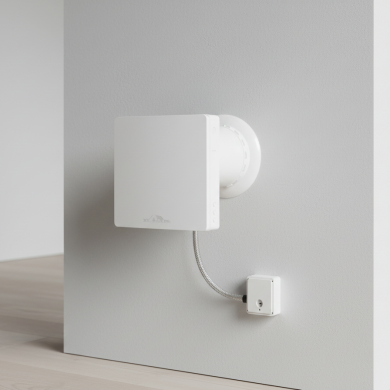
As the building envelope is tightened, the passive air exchange (draftiness) that older homes relied on for drying is eliminated. Consequently, mechanical ventilation becomes a critical life-safety system, not just an amenity. High airtightness without balanced ventilation leads to elevated indoor humidity, condensation on cold surfaces, and poor indoor air quality (IAQ). The integration of an Energy Recovery Ventilator (ERV) is superior to a Heat Recovery Ventilator (HRV) in the Maritime climate.
An ERV transfers both heat and moisture, helping to maintain indoor relative humidity in the optimal range (30–50%) during winter while reducing latent cooling loads in humid summers. This mechanical intervention must be paired with smart monitoring. Install sensors to track CO2 and humidity levels. By coupling a tight, breathable envelope with active ventilation, we transform a leaky, energy-intensive heritage house into a stabilized, comfortable ecosystem. The result is a structure that retains its 19th-century aesthetic but operates with 21st-century efficiency.
Data: Retrofit Risk and Mitigation Matrix
The following table outlines common retrofit actions and their associated risks in a heritage context, along with technical mitigation strategies.
| Retrofit Action | Heritage/Aesthetic Risk | Hygrothermal/Technical Risk | Mitigation Strategy |
| Exterior Wall Insulation | Loss of original cladding, trim, and shadow lines. | Low risk; keeps structure warm/dry. | Use ventilated rainscreens with replica trim; consult heritage planner. |
| Interior Wall Insulation | Loss of interior moldings; floor space reduction. | High Risk: Cold sheathing/masonry, freeze-thaw damage, condensation. | Use vapor-open insulation (wood fiber/mineral wool); WUFI modeling; no poly barriers. |
| Window Replacement | Inappropriate frame thickness; loss of historical glass. | Installation air leakage; water ingress at sill. | Repair sash + storms first. If replacing, use slim-profile European thermally broken frames. |
| Air Sealing | None. | Trap indoor moisture; back-drafting combustion appliances. | Install ERV for balanced ventilation; switch to sealed combustion units. |
| Foundation Insulation | Concealment of historic stone foundation. | Rising damp; capillary suction into insulation. | Install capillary break; manage exterior drainage first; use moisture-resistant foam (e.g., Osblock systems). |
Conclusion
Successfully retrofitting a Maritime heritage home requires a paradigm shift from simple renovation to conservation science. By respecting the hierarchy of interventions—managing water first, optimizing the envelope second, and upgrading mechanicals third—builders and homeowners can avoid the catastrophic failures often associated with “green” upgrades on older buildings. We must move beyond abstract R-values and focus on assembly drying potential, reversibility, and aesthetic fidelity. Utilizing modern technologies like Osblock foundations, breathable membranes, and slim-profile high-performance windows allows us to bridge the gap between history and efficiency. Ultimately, this approach yields a property that is not only comfortable and low-carbon but also structurally resilient, ensuring the cultural heritage of the Maritimes survives for the next century of habitation.