Your Home as a Material Bank: A Strategic Guide to Material Passports
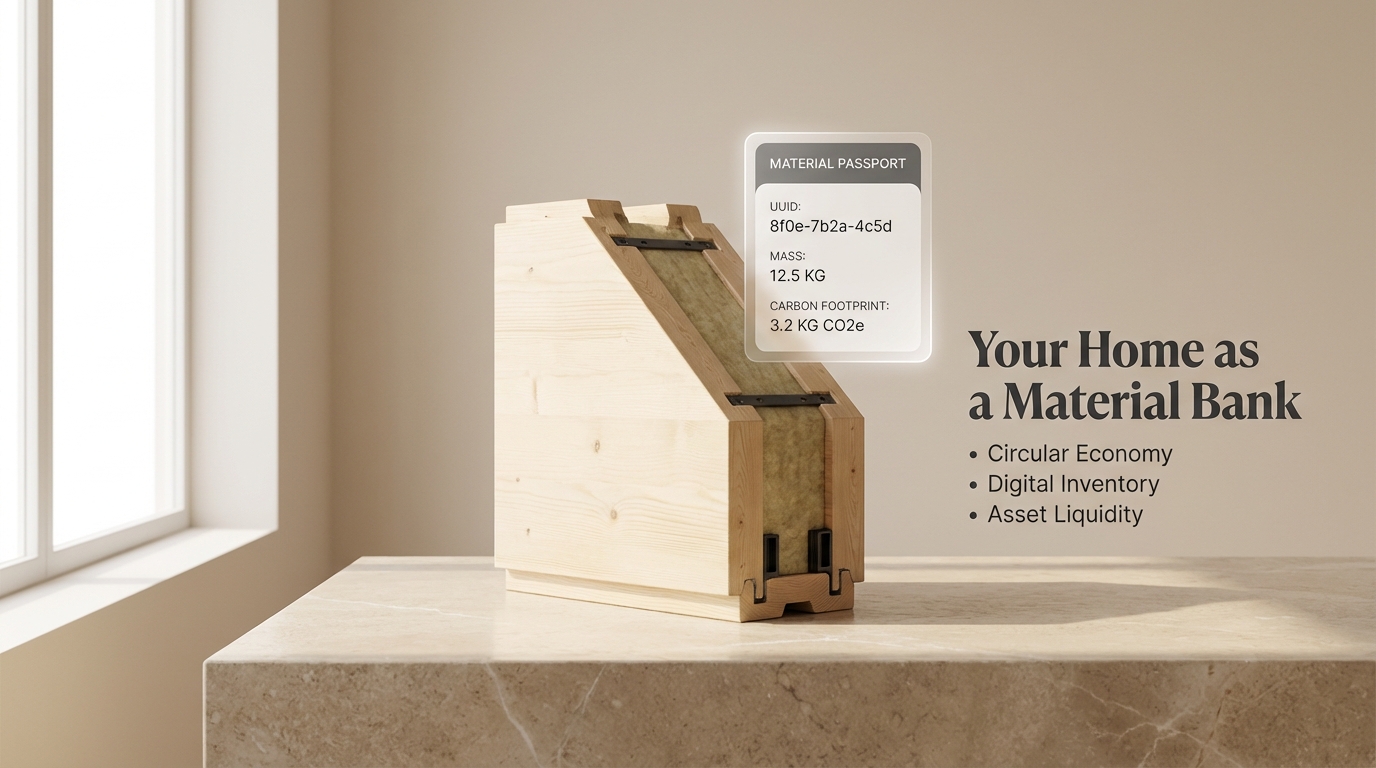
The construction industry is currently transitioning from a linear "take-make-waste" model to a circular economy where buildings function as recoverable material banks. In this context, a Material Passport is no longer a theoretical concept but an emerging asset management tool driven by regulatory frameworks like the EU Digital Product Passport (DPP) and market demand for verifiable sustainability. This article serves as a tactical operational playbook for builders and owners to document Vybuild components—specifically Osblock, VY Flex House modules, and EPD-backed windows—for future recovery. We will examine how to execute a project-ready passport, covering critical data capture, physical tagging protocols, storage architectures, and methods for estimating both embodied carbon and future resale value. By treating building layers as temporary deposits of valuable resources, contractors can unlock new revenue streams from deconstruction and provide clients with tangible asset liquidity.
The Strategic Case for Material Passports
The concept of the building as a material bank (BAMB) fundamentally alters the economic calculation of construction. Traditionally, end-of-life scenarios for buildings involved demolition costs; the material passport flips this dynamic by identifying recoverable value. With the acceleration of the Ecodesign for Sustainable Products Regulation (ESPR) and the adoption of standards such as ISO 14040/44, documenting the provenance and composition of building elements is becoming a prerequisite for future-proofing assets. For modular solutions like Vybuild’s VY Flex House or Osblock systems, the potential for high-fidelity recovery is significantly higher than in conventional stick-frame construction. A robust passport system allows these components to be treated as distinct assets that retain value on secondary markets, rather than construction debris.
Furthermore, the financial implication extends to current project accounting. Green building certifications and public procurement pilots increasingly reward material traceability. By providing a detailed inventory—linking physical assets to digital representations—builders differentiate their service offering. This documentation facilitates maintenance efficiency during the use phase and enables surgical deconstruction at the end of the service life. The passport effectively transforms a static property into a database of tradable commodities, mitigating the financial risks associated with future raw material scarcity and disposal taxation.
Core Data Requirements and Inventory Strategy
A material passport is only as valuable as the data it contains. To ensure interoperability with platforms like Madaster or generic BIM tools, builders must capture a specific set of attributes for every high-value component. The operational goal is to create a "Minimal Viable Passport" that balances granularity with administrative feasibility. This requires shifting from generic descriptions to precise, unique identifiers (UUIDs) linked to technical specifications. The data entry process should prioritize elements with the highest embodied carbon and resale potential, such as structural modules, fenestration, and mechanical ventilation systems.
The following table outlines the essential data fields required for key Vybuild components to ensure they meet circular economy standards:
| Component Category | Required Identifiers | Performance Data | Recovery Strategy |
|---|---|---|---|
| VY Flex House Modules | Serial No., UUID, Grid Coordinates | Mass (kg), Structural Drawings, Module-level EPD | Reuse: Disconnect MEP couplers, unbolt base plates, lift via designated points. |
| Osblock Systems | Batch No., Block Type, Density | Thermal Resistance (R/U-value), Material Composition | Recycle/Reuse: Dry-stack allows disassembly; mortared requires crushing for aggregate. |
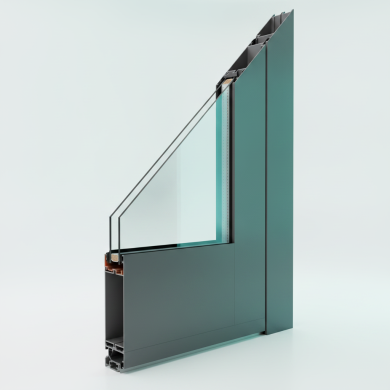
| Windows & Glazing | Manufacturer Model, Prod. Date | U-value, Solar Heat Gain (SHGC), Frame Material EPD | Resale: Remove via frame anchors; protect thermal break during transport. |
| ERV Systems | Model, Firmware Version, Serial | Fan Efficiency Curve, Heat Recovery Rate | Refurbish: High resale value for parts or whole unit if maintenance log is intact. |
Physical Tagging and Digital Linkage
Data residing solely in a cloud server is vulnerable to loss over a building’s multidecade lifespan. Therefore, a redundant physical tagging system is essential to bridge the gap between the digital twin and the physical reality. Best practices dictate the use of durable identifiers—such as stainless steel or anodized aluminum plates—that can withstand environmental stress and mechanical wear. These tags should feature a QR code for instant access to the digital passport and a human-readable alphanumerical ID (e.g., VY-WIN-A2-001) to ensure identification remains possible even if digital links break or require manual lookup.
Placement strategy is critical for future accessibility. For windows, tags should be riveted to the head jamb or sash pack edge, invisible when closed but accessible during inspection. For modular units like the VY Flex, NFC chips embedded in the cavity combined with visible plates on the chassis ensure that data is retrievable even if surface finishes are altered. In the case of Osblock walls, a master plate located at the service entrance or first block row should map the batch numbers to specific wall sections. This "phygital" (physical + digital) approach ensures that future deconstruction crews can instantly verify the load-bearing capacity, hazardous material status, and disassembly method of any component.
Calculating Embodied Carbon and Salvage Value
The material passport serves as the foundational dataset for two critical calculations: embodied carbon estimation and residual financial value. For embodied carbon, the industry standard relies on Environmental Product Declarations (EPDs) compliant with EN 15804. Builders can perform a quick "check" by multiplying the quantity of a component by its unit mass and the carbon factor found in the EPD (kgCO2e/kg). This calculation, summed across the building and adjusted for a transport/installation factor (typically 1.05–1.15), provides a defensible baseline for the structure’s carbon footprint, verifiable via tools like EC3 or One Click LCA.
Simultaneously, the passport enables the estimation of salvage value, turning waste into revenue. The formula for this estimation is: Salvage Value = (Quantity × Unit Resale Price × Condition Factor × Demand Factor) – Deconstruction Cost. The "Condition Factor" (ranging from 0.0 to 1.0) is maintained through regular updates to the passport during the maintenance phase. For example, a VY Flex module kept in pristine condition might retain 70-80% of its value, whereas a mortared block wall may only have value as crushed aggregate. By documenting connection types—specifically distinguishing between mechanical connections (bolts, screws) and chemical bonds (glues, mortars)—builders can accurately forecast deconstruction costs and project the net recoverable value of the asset.
Operational Workflow for Builders and Owners
Implementing a material passport requires integrating data capture into the existing construction workflow rather than treating it as a post-handover task. The process begins at procurement, where EPDs and technical datasheets are collected and assigned to specific batch numbers. During the installation phase, technicians should scan component tags and upload "as-built" photos showing connection details and concealed services. This visual evidence is crucial for future disassembly, proving that a unit can be removed without structural damage.
Upon project completion, the data aggregates into a deliverable package—a two-layer storage system. The "Live" layer resides in a BIM environment or a dedicated platform like Madaster for professional management. The "Accessible" layer is a static export (PDF + CSV) provided to the building owner, ensuring they possess legal ownership of the data. For Vybuild projects, this means handing over a digital manual that explicitly instructs future owners on how to monetize their home’s components. This operational discipline ensures that the intent of circularity is preserved, allowing the building to function effectively as a material bank from day one.
Transforming a home into a material bank requires a shift in documentation strategy rather than just construction methodology. By implementing the material passport protocols outlined—systematic data capture, durable tagging, and lifecycle calculation—builders position assets for future liquidity and regulatory compliance. The integration of Vybuild products into this framework demonstrates that circularity is operational today, not a future target. For contractors, the ability to deliver a digital twin alongside the physical structure offers a competitive advantage in a market increasingly sensitive to embodied carbon and asset recovery. The immediate action for industry professionals is to adopt the ten-point data standard and begin tagging high-value components, ensuring the built environment serves as a recoverable reservoir of resources rather than a future liability.