Interactive Construction Logic: Gamifying the Retrofit vs. New Build Decision Tree
Content marketing in the high-performance construction sector often suffers from engagement fatigue. Audiences are saturated with static technical bulletins, isolated building science diagrams, and generic sales scripts. The standard approach fails to address the paralysis analysis that plagues homeowners and developers: the inability to visualize how singular technical specifications compound into financial and environmental outcomes. The solution lies in shifting from passive education to active simulation. By structuring Instagram carousels as gamified decision trees—specifically the "Choose Your Build" concept—we transform abstract trade-offs into tangible Key Performance Indicators (KPIs). This framework allows stakeholders to simulate a Retrofit, New Build, or Modular Replacement, selecting specific variables such as Osblock insulation, heat pump topology, and glazing standards. The result is not merely engagement; it is a consultative simulation that demonstrates the operational and embodied carbon delta of specific Vybuild product integrations.
Structural Logic of the Gamified Carousel: UX and Architecture
The efficacy of a decision-tree carousel relies on rigorous user experience (UX) design that navigates the linear constraints of the Instagram platform. Unlike a website, a carousel offers a single lateral navigation path. Therefore, the architecture must utilize visual anchoring and explicit instructional design to simulate branching logic. The recommended structure utilizes a hybrid model: the social asset functions as an exploratory simulation, while a linked microsite executes precise calculations. The carousel should present three distinct entry points: Retrofit (capitalizing on existing structure), New Build (optimizing for perfect orientation), and Modular Replace (VY Flex House implementation for speed and precision).
Carousel Navigation Strategy:
- The Hook (Slide 1-2): Establish the baseline scenario (e.g., 150m2 structure, Zone 5 climate). The user is prompted to select a path, with visual cues directing them to skip to specific slide ranges (e.g., "Swipe to Slide 4 for Modular").
- The Variables: Each path must offer identical decision nodes to ensure comparability. These nodes are Insulation, Heating, and Glazing.
- Visual Continuity: Use color-coded borders (Blue for Retrofit, Green for New Build, Orange for Modular) to prevent user disorientation during rapid swiping.
| Build Path | Primary Constraint | Key Advantage | Target Audience |
|---|---|---|---|
| Retrofit | Existing geometry/thermal bridges | Lower embodied carbon (structure retained) | Urban owners, preservationists |
| New Build | High upfront capital/permitting | Maximized envelope efficiency | Custom clients, developers |
| Modular (VY Flex) | Transport logistics | Speed, QC, fixed costs | Investors, ADU market |
Technical Branching: Product Specifications and Trade-offs
The core value proposition of this asset is the detailed comparison of technical specifications. This is not a superficial overview; it is a comparative analysis of building physics. Each decision node must present the "Standard" option against the "High-Performance" Vybuild alternative, clearly delineating the consequences of each choice.
Node A: Envelope & Insulation
The choice is between standard cavity insulation and Osblock systems. The narrative here focuses on thermal bridging and airtightness rather than just R-value.
Osblock Specs: Continuous insulation minimizes thermal bridging; integrated structure reduces labor time. Emphasize the reduction in air changes per hour (ACH50).
Cavity Specs: Standard fiberglass/cellulose. High risk of installation defects and moisture accumulation in retrofits.
Node B: Mechanical Systems
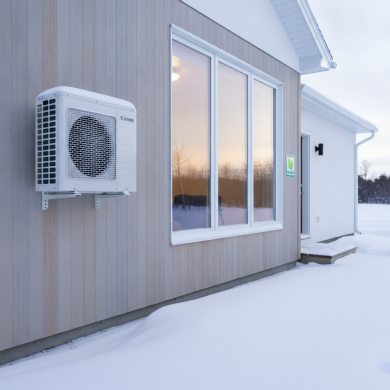
Heat Pump (ASHP/GSHP): Highlight Coefficient of Performance (COP) ranging from 2.5 to 4.0. Connect this to the airtightness achieved in Node A—high-performance envelopes reduce the tonnage required for the HP system, lowering CapEx.
Electric Boiler: Resistive heating (COP 1.0). While CapEx is low, OpEx is tied directly to grid volatility. This option serves as the control variable to demonstrate the "cost of inaction."
Node C: Glazing & Ventilation
European Windows: Discuss triple-glazing, tilt-turn functionality, and high solar heat gain coefficients (SHGC) tailored to the orientation. Frame insulation values must be highlighted.
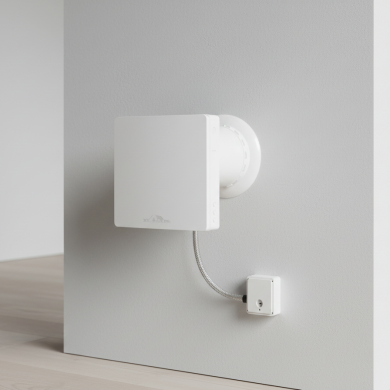
ERVs (Energy Recovery Ventilators): Essential for the Osblock/VY Flex paths. Explain the necessity of mechanical ventilation when building tight to manage humidity and CO2 levels.
Quantifying Outcomes: The KPI Calculation Engine
The final slides of the carousel must deliver the "payoff"—a synthesized scorecard that aggregates the user’s choices into hard data. This transitions the content from theoretical to actionable. The credibility of the post rests on the accuracy and presentation of these figures.
Key Performance Indicators (KPIs) to Display:
- Annual Energy Demand (kWh/yr): Calculated as Baseline Demand × (1 – Envelope Improvement) × (1 – System Efficiency). Show the drastic delta between a leaky Retrofit with a boiler versus a Modular Replace with Osblock and Heat Pumps.
- Operational Cost ($/yr): Apply a standard regional kWh rate (e.g., $0.20/kWh). This creates an immediate emotional reaction regarding monthly cash flow.
- Embodied Carbon Delta (kgCO2e): A critical metric for the sophisticated audience. Acknowledge that high-performance materials (triple pane windows, foam) have higher initial carbon, but visualize the "Carbon Payback Period"—the point at where operational savings eclipse the initial carbon investment.
- Financial Payback: A simple ROI calculation comparing the incremental cost of Vybuild products against annual utility savings.
Commercial Application: Contractor Tooling and Lead Generation
This content strategy functions as a dual-purpose asset: educational material for the homeowner and a sales enablement tool for the contractor. By gamifying the trade-offs, we provide contractors with a script for overcoming price objections.
The Consultative Sales Script:
Contractors can pull up this carousel during client meetings to co-design the project scope. When a client pushes back on the cost of European windows or Osblock, the contractor uses the carousel to demonstrate the downstream effect on equipment sizing and long-term comfort. The visual "consequence" of choosing the cheaper path (higher bills, lower resilience) creates a psychological loss aversion.
Financing & Incentives Integration:
To close the decision loop, the final slide must bridge the gap between technical desire and financial reality. List specific mechanisms: PACE financing, Green Bank loans, and Heat Pump rebates. The Call to Action (CTA) should drive users to the microsite to generate a "Contractor-Ready Spec Sheet," effectively capturing high-intent leads who have already pre-qualified themselves by engaging with the technical nuances of the decision tree.
In conclusion, the "Choose Your Build" carousel represents a strategic pivot in construction marketing. It respects the intelligence of the audience by providing density and data rather than slogans. By simulating the complex interplay between Retrofit, New Build, and Modular methodologies—and rigorously testing variables like Osblock insulation and European glazing—we empower stakeholders to make evidence-based decisions. This format elevates the conversation from simple material costs to holistic project value, encompassing carbon, resilience, and operational economics. For Vybuild, this establishes authority not just as a product manufacturer, but as a solutions architect for the next generation of high-performance housing.