Green financing & resale value: The 2026 Atlantic Canada guide to high-performance homes
Did you know that hitting specific EnerGuide targets can instantly trigger a 25% refund on your mortgage loan insurance premiums through CMHC? For a typical Prince Edward Island homebuyer putting less than 20% down, this translates to thousands of dollars in immediate cash back, not to mention the monthly utility savings. Most buyers in Charlottetown and Summerside look at the sticker price, but savvy investors and homeowners in 2026 are pivoting to Total Cost of Ownership (TCO). In this article, you will learn how to leverage high-performance building materials—specifically R-32 insulated woodform blocks and European glazing—to unlock green financing incentives, increase appraisal values, and sell homes faster in a high-rate environment.
The green mortgage advantage in Atlantic Canada
Financing an energy efficient home in PEI is no longer just about saving on heat; it is about accessing better capital. In 2026, programs like the CMHC Eco Plus and Sagen’s Energy Efficient Housing Program offer substantial incentives for homes that exceed building code standards. To qualify, a property generally needs to be 20% more efficient than a typical new construction or achieve a specific EnerGuide rating. This is where the choice of structural shell becomes a financial instrument.
Traditional stick framing often struggles to bridge the gap between “code minimum” and “green mortgage qualified” without expensive add-ons like exterior rigid foam or complex double-wall systems. By utilizing insulated woodform blocks, builders and homeowners hit effective R-32 wall insulation values immediately. This single upgrade frequently pushes the energy model across the threshold required for the 25% premium refund. For a home valued at $450,000 with a standard high-ratio mortgage, qualifying for this refund puts approximately $4,500 back into the homeowner’s pocket—covering the cost difference of the premium materials instantly.
Key financing metrics for 2026:
- CMHC Eco Plus: Up to 25% premium refund for EnerGuide scores typically 20% better than code.
- Amortization extensions: Emerging lender products now offer 30-year amortizations for confirmed high-performance builds, lowering monthly pressure.
- Qualifying ratios: Lower estimated heating costs (e.g., $50/month vs $350/month) reduce your Total Debt Service (TDS) ratio, allowing you to qualify for a higher purchase price.
Translating R-value to appraisal value
One of the biggest friction points in the Atlantic real estate market is the “appraisal gap.” Appraisers rely on comparable sales (comps), and often, a high-performance home is compared against a standard code-built neighbor. To maximize valuation, you must provide the appraiser with a “Green Addendum” or specific data points that justify the premium. You cannot rely on visual inspection alone; insulation is invisible once the drywall is up.
When presenting a home built with insulated woodform blocks or renovated with high-performance European windows, you must quantify the “Operating Cost Capitalization.” This is the logic that a dollar saved in operating costs increases the property’s value by a multiple of that savings. In the maritime climate of PEI, where the average winter temperature hovers around -7°C and wind chill is significant, thermal breaks and air tightness are tangible assets.
Data to provide your appraiser:
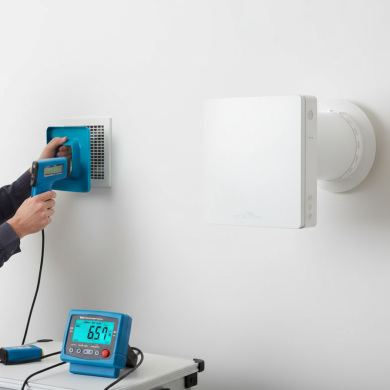
- Blower door test results: A standard home might test at 3.0 ACH50. A home built with our insulated woodform system often hits nearly 0.5 ACH50 (Passive House levels). This drastic reduction in air leakage protects the structural integrity from moisture and lowers HVAC loads.
- The R-Value comparison: Explicitly state: “Standard 2×6 wall = R-22 effective. Subject Property Wall = R-32 effective continuous insulation.”
- Durability factor: Note that the woodform blocks are rot-resistant and engineered for high wind loads, reducing long-term maintenance reserves required by the owner.
The seller’s playbook: marketing monthly cashflow
For Realtors and sellers in Nova Scotia and PEI, the conversation must shift from “Listing Price” to “Monthly Cashflow.” In a high-interest rate environment (even as rates stabilize in 2026), buyers are payment-sensitive. A home that costs $400,000 but requires $400/month in heat is financially identical to a home costing $460,000 with $50/month in heat. The difference is that the more expensive, efficient home builds equity, while the inefficient home burns cash.
We recommend creating a “Home Energy Resume” for listing presentations. This document highlights the specific technologies—like European tilt-and-turn windows and ERV systems—that drive savings. Below is a model of how to present this data to prospective buyers to justify a higher asking price.
| Metric | Standard PEI Bungalow (2010 Build) | VY Build Performance Home (2026) |
|---|---|---|
| Wall Insulation | R-20 (Batt with thermal bridging) | R-32 (Continuous Woodform) |
| Windows | Double Pane Vinyl (U-0.35) | Euro Triple Pane (U-0.14) |
| Annual Heating Cost* | $3,200 | $650 |
| Monthly “carried cost” equivalent | -$266/mo (Lost to utility) | +$210/mo (Available for mortgage) |
| Buying Power Impact | Baseline | +$35,000 borrowing capacity |
*Based on average Maritime electricity rates and heating degree days for Charlottetown.
Practical tips: The 2026 sale-ready checklist
If you are planning to build or sell in Atlantic Canada this year, take these steps to lock in value:
- Get a pre-drywall blower door test: If you are building, test early. Documenting airtightness before closing up walls proves construction quality to future buyers.
- Keep the “stickers”: Keep the NFRC labels on your European windows until after the appraisal inspection. The visual proof of U-values is critical for the appraiser’s file.
- Draft a “Green Feature Sheet”: Don’t just list “energy efficient.” List “R-32 Insulated Woodform Walls – 40% reduction in heating load.” Specificity sells.
- Contact VY Build early: If you are planning a build or an addition, contact us during the design phase. We can provide the R-value calculations and specifications your mortgage broker needs to pre-qualify you for green financing programs.
Local context: navigating PEI & Atlantic incentives
In Prince Edward Island and the broader Atlantic region, the regulatory landscape is shifting rapidly to favor efficiency. The efficiencyPEI rebates continue to evolve, offering significant grants for new home construction that meets net-zero ready standards. Furthermore, municipalities like Charlottetown and Stratford are increasingly focused on climate resilience. Building with insulated woodform blocks not only meets energy goals but addresses the reality of Atlantic storms; these structures offer superior resistance to wind-driven rain compared to standard vinyl-on-OSB construction.
Local lenders are also becoming more sophisticated. Credit unions and major banks in the Maritimes now have specific underwriters familiar with high-performance modular and woodform construction. By presenting a project that aligns with the National Building Code’s tiered energy performance roadmap, you position your property as a “future-proof” asset, reducing risk for the bank and increasing desirability for the buyer.
Secure your investment
Energy efficiency is the new currency in Atlantic Canada’s real estate market. Whether you are building a new home, planning a modular annex for rental income, or looking to maximize resale value, the materials you choose today dictate your financial flexibility tomorrow. Do not leave money on the table with outdated building methods.
Ready to build a finance-friendly asset?
Contact VY Build today for a free consultation on high-performance construction packages.
Phone: (902)-629-6699
Email: info@vybuild.ca
Website: vybuild.ca