Beyond Operational Efficiency: The Low-Carbon Construction Playbook for Atlantic Canada
You are preparing a response to an RFP for a multi-unit housing development in Charlottetown or Halifax, and for the first time, the scoring matrix heavily weighs "lifecycle carbon assessment" alongside cost and timeline. This is becoming the standard reality: while the built environment generates nearly 40% of annual global CO2 emissions, in highly efficient new builds, embodied carbon associated with materials and construction can account for up to 50% of the structure’s total carbon footprint before a single tenant moves in. Developers and municipal procurement officers in Atlantic Canada must now pivot from solely evaluating operational efficiency (heating costs) to addressing the carbon cost of the build itself. This article provides a technical framework for measuring embodied carbon, implementing design-for-deconstruction (DfD) strategies, and utilizing VY Build’s modular and R-32 insulated woodform systems to meet the stringent 2026 procurement mandates emerging across the Maritimes.
Quantifying embodied carbon in Atlantic residential projects
The Atlantic Canadian construction sector has historically focused on thermal resistance due to our Zone 6 and 7 climates. However, as operational carbon decreases through heat pumps and tighter envelopes, the carbon intensity of the materials themselves—the embodied carbon—becomes the dominant environmental impact. For developers targeting net-zero or municipal partnerships, the choice of structural system is the primary lever for reducing this footprint.
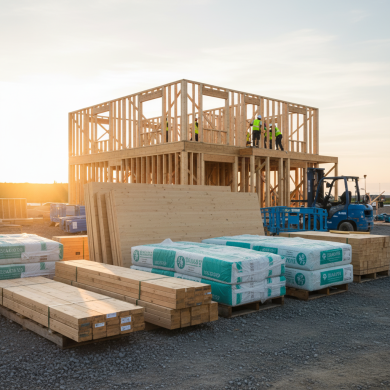
Traditional concrete foundations and stick framing with heavy thermal bridging present a high carbon penalty. Concrete production is energy-intensive, and on-site framing generates significant waste (often 10-15% of lumber volume). In contrast, prefabricated modular units and insulated woodform blocks offer a distinct advantage: precision manufacturing reduces waste to near zero, and the primary material (wood) serves as a carbon sink. The table below outlines a calculated comparison for a theoretical 1,000 ft² residential unit built in PEI, contrasting a standard code-built structure with a VY Build high-performance approach.
| Metric | Standard Stick-Build + Concrete ICF | VY Build Modular / Woodform System | Delta |
|---|---|---|---|
| Material Waste Factor | 12-15% (Landfill destination) | < 2% (Factory recycled) | -85% Waste Volume |
| Embodied Carbon (kgCO2e/m²) | ~180-220 | ~90-110 | ~50% Reduction |
| Site Disruption | High (Excavation, long duration) | Low (Helical piles, crane set) | Reduced Soil Disturbance |
| Thermal Bridge Factor | 25% Framing Factor | Continuous Insulation (R-32) | Superior Envelope Integrity |
Designing for deconstruction and asset recovery
To align with circular economy principles, Atlantic developers must shift their perspective on buildings: viewing them not as static disposable assets, but as material banks. Design for Deconstruction (DfD) ensures that components can be recovered, refurbished, and resold at the end of the building’s useful life. This is particularly relevant for temporary housing solutions or municipal infill projects where land use may change over 20-30 years.
VY Build’s modular units and insulated woodform blocks are engineered for this precise lifecycle. Unlike traditional Insulated Concrete Forms (ICF), which create a monolithic concrete wall that requires energy-intensive demolition to remove, woodform blocks act as structural insulated panels that can be disassembled. When specifying for DfD in Atlantic Canada, prioritize mechanical connections over chemical bonds.
- Connection Details: Use accessible bolts and screws rather than adhesives or nails for structural connections. Modular units should be secured to foundations (such as helical piles) using reversible brackets.
- Service Routing: distinct separation of mechanical, electrical, and plumbing (MEP) systems from the structural shell allows for upgrades without destroying the envelope. Surface-mounted chases or accessible bulkheads are preferable to burying lines in spray foam.
- Module Integrity: High-performance modular units retain their structural integrity during transport. This means a development in Stratford can be decommissioned in 2040, the units refurbished, and relocated to Summerside, retaining 80-90% of the initial material investment.
The financial case: Lifecycle cashflow and salvage revenue
The economic argument for low-carbon, circular construction extends beyond environmental altruism; it is a risk mitigation strategy against rising waste management costs and a method for unlocking residual value. In PEI and Nova Scotia, landfill tipping fees for Construction, Renovation, and Demolition (CRD) waste are steadily increasing, and regulatory pressure is mounting to ban organic and wood waste from landfills entirely.
A standard demolition cost for a 2,000 sq ft home can range from $15,000 to $25,000 CAD, a pure sunk cost. Conversely, a deconstruction strategy utilizing modular components turns that liability into a potential revenue stream. By 2026, we project a secondary market for certified, energy-efficient modular shells will emerge, driven by housing shortages. A developer holding assets that can be unbolted and sold rather than demolished creates a stronger balance sheet. When modeling project pro-formas, include a "Salvage Value" line item for modular assets, typically estimated at 15-25% of initial shell cost after 20 years, provided the envelope has been maintained. This residual value significantly lowers the total cost of ownership (TCO) compared to traditional builds where end-of-life value is negative due to demolition costs.
Meeting 2026 procurement mandates in Atlantic Canada
Municipalities across the Atlantic provinces are harmonizing their procurement strategies with federal climate goals. By 2026, we anticipate that Requests for Proposals (RFPs) for affordable housing and public infrastructure will require mandatory Environmental Product Declarations (EPDs) and embodied carbon limits. To secure these contracts, developers must adopt a "low-carbon first" approach.
To qualify projects against emerging federal/provincial low-carbon procurement signals:
- Pre-Tender Specification: Explicitly specify "prefabricated volumetric modular" or "R-32 insulated woodform" systems in the design phase to lock in carbon savings.
- Documentation: Partner with suppliers who can provide data on material sourcing. VY Build’s systems utilize regionally sourced lumber where possible, reducing transportation emissions—a key metric in Scope 3 carbon accounting.
- Scoring Alignment: In your proposal, map the benefits of the woodform system directly to the RFP’s sustainability rubric. Highlight the "Speed of Assembly" not just as a schedule benefit, but as a carbon reduction metric (fewer generator hours, less site traffic, reduced community disturbance).
Practical Action Plan: The Circular Build Checklist
Implement these steps to reduce risk and carbon in your next development:
- Calculate Before Breaking Ground: Use a simplified embodied carbon calculator to compare your standard wall assembly against an R-32 woodform block system.
- Specify Mechanical Fasteners: Instruct engineering teams to detail connections that allow for non-destructive disassembly, particularly for foundation-to-frame connections.
- Plan for End-of-Life: Draft a "Deconstruction Plan" as part of your project file—this is increasingly becoming a requirement for Green municipal funding.
- Consult on Modular Integration: Contact VY Build to review how modular units can be integrated into your existing site plans to reduce CRD waste.
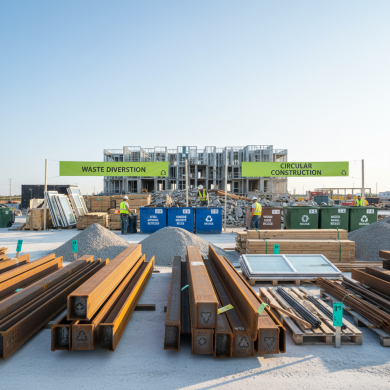
- Audit Waste Streams: Set a target of <5% site waste diversion for your next project.
Local Context: The Maritime Advantage
The Atlantic Canadian climate presents specific challenges for circularity—salt air, high wind loads, and freeze-thaw cycles can degrade materials, rendering them unsuitable for salvage if not properly protected. This is where the R-32 insulated woodform block excels. Unlike traditional timber framing which can suffer from moisture entrapment in our humid climate, the continuous insulation and tight vapor management of these blocks preserve the structural wood core. For developers in coastal communities like North Rustico or Souris, this durability ensures that the "material bank" remains solvent. Furthermore, utilizing efficiencyPEI’s New Home Construction rebates and aligning with the CMHC MLI Select program (which offers insurance premiums incentives for energy efficiency) can offset the initial transition costs to these advanced building systems.
Conclusion
The transition to a circular, low-carbon construction economy in Atlantic Canada is no longer theoretical—it is an impending regulatory and economic reality. By shifting focus from operational energy to embodied carbon and design for deconstruction, developers can future-proof their portfolios against 2026 procurement mandates and rising waste costs. VY Build’s modular units and insulated woodform blocks provide the technical solution to this challenge, offering a pathway to build assets that are faster to deploy, lower in carbon, and valuable at every stage of their lifecycle. To evaluate the carbon and cost impacts for your specific project, or to discuss modular logistics for your next tender, contact VY Build for a technical consultation.
Phone: (902)-629-6699
Email: info@vybuild.ca
Website: vybuild.ca