Building local modular assembly hubs: A municipal playbook for Atlantic Canada
Municipalities across Atlantic Canada face a dual crisis: a staggering housing deficit projected to reach 30,000 units by 2026, and a construction workforce nearing retirement age without sufficient replacement. For economic developers and town planners in communities like Summerside, Moncton, or Truro, the traditional reliance on importing finished modular units from central Canada bleeds up to 40% of project capital into logistics and out-of-province manufacturers. This article outlines a scalable alternative: the Local Modular Assembly Hub. By establishing regional light-manufacturing sites that assemble high-performance insulated woodform blocks into housing units locally, municipalities can cut delivery timelines by 30%, retain construction wages within the community, and deploy climate-resilient housing specifically engineered for Maritime winters.
The economic case: Stopping the ‘logistics bleed’ of imported housing
The current model of importing finished volumetric modular homes to Atlantic Canada is economically inefficient. Shipping fully assembled modules means paying to transport ‘air’—trucking large, empty volumes across provincial borders. This logistical burden significantly increases the cost per square foot without adding value to the home itself.
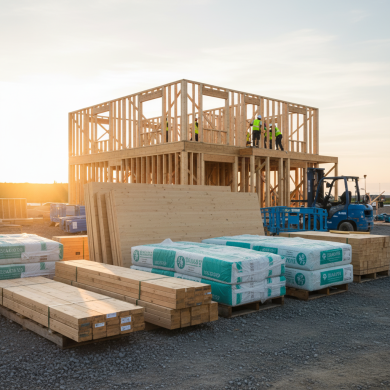
A Local Modular Assembly Hub shifts this paradigm. Instead of importing finished homes, municipalities or regional partners import high-density, flat-packed components—specifically insulated woodform blocks. These components are then assembled into wall panels or complete modules at a local facility. This approach drastically reduces freight costs and carbon emissions while keeping the value-add (labour and assembly) within the local economy.
Comparative Project Economics (50-Unit Development):
| Cost Component | Imported Modular (Central Canada) | Local Assembly Hub (VY Build Model) | Impact |
|---|---|---|---|
| Logistics & Freight | $12,000 – $15,000 per unit | $2,500 – $3,500 per unit | ~75% Savings |
| Local Labour Retention | 5% (Site set only) | 65% (Assembly + Site set) | High Economic Multiplier |
| Build Timeline | 12-16 weeks (factory queue dependent) | 8-10 weeks (parallel local assembly) | 30% Faster Occupancy |
| Wall Insulation Value | R-22 (Standard Code) | R-32 (Insulated Woodform) | 40% Energy Reduction |
Site selection and Capex: The lightweight infrastructure model
Unlike traditional modular factories requiring millions in heavy automation and overhead cranes, a Local Assembly Hub leveraging insulated woodform technology requires minimal Capital Expenditure (Capex). Because the building blocks are lightweight and self-aligning, the assembly process resembles large-scale joining rather than heavy construction.
Ideal Site Specifications for an Atlantic Municipality:
- Facility Type: Existing warehouse, vacant big-box store, or large agricultural structure.
- Size: 5,000 – 10,000 sq. ft. for a throughput of 2-4 units per month.
- Ceiling Height: Minimum 16-18 ft clear height to allow for wall panel tipping.
- Doors: 14 ft grade-level doors for loading finished wall sections or pods.
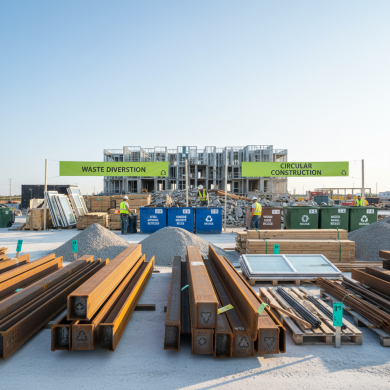
- Yard: 1-acre gravel or paved yard for staging weather-resistant insulated woodform pallets.
Estimated Startup Equipment Package:
- 1x Standard Forklift (5,000 lb capacity)
- Basic carpentry stations (mitre saws, table saws)
- Panel assembly tables (can be site-built)
- Total Estimated Equipment Capex: Under $75,000 CAD (excluding building lease).
This low barrier to entry allows smaller municipalities or housing co-ops to operationalize a hub within 3-4 months, utilizing underused industrial assets rather than waiting years for new heavy industry construction.
Workforce development: Transforming unskilled labour into skilled assemblers
The Atlantic construction sector is severely constrained by a lack of red-seal carpenters. The VY Build hub model bypasses this bottleneck by simplifying the construction method. The core technology—insulated woodform blocks—functions as a “lock-and-load” system. It eliminates the need for complex measuring, stud spacing, and vapor barrier application typically required in stick framing.
Hub Workforce Structure (per shift):
- 1 Site Lead / Red Seal Carpenter: Oversees quality control and code compliance.
- 4-6 General Assemblers: Can be sourced from workforce reentry programs, apprenticeships, or general labour pools. Training time to proficiency is approximately 2 weeks.
This model creates an immediate pipeline for local employment. By partnering with institutions like Holland College or NBCC, these hubs serve as practical training grounds where students gain hours toward certification while producing tangible housing assets for their community.
Practical Tips: Launching a Municipal Pilot
For economic development officers looking to initiate a pilot project in 2026:
- Audit Industrial Assets: Identify one underutilized municipal building or warehouse (min 5,000 sq ft) suitable for light assembly.
- Aggregate Demand: Bundle housing needs from local non-profits or senior housing requirements to create a guaranteed offtake order of 10+ units.
- Review Zoning: Ensure the target site allows for “Light Manufacturing” or “Construction Assembly.”
- Contact VY Build: Request the “Hub Partnership Assessment” to evaluate your site’s suitability and supply chain logistics.
Climate resilience and 2026 funding alignment
Building in Atlantic Canada requires specific attention to our climate zone (Zone 6/7). A standard code-built home often struggles with the freeze-thaw cycles, high humidity, and wind-driven rain characteristic of the Maritimes. The insulated woodform blocks used in these hubs provide a continuous thermal break with an effective R-value of R-32, significantly exceeding the National Building Code requirements.
Funding Pathways for 2026:
- CMHC Housing Accelerator Fund: Supports initiatives that modernize zoning and permit accelerated construction methods like off-site assembly.
- ACOA Regional Economic Growth through Innovation (REGI): Applicable for capital equipment adoption that improves productivity (e.g., establishing the assembly line).
- efficiencyPEI / EfficiencyNS: High-performance building envelopes (R-32) often qualify for top-tier rebates and Green Municipal Fund grants for net-zero ready pilots.
- FCM Green Municipal Fund:Specifically targets capital projects that reduce GHG emissions—local assembly drastically cuts transportation carbon compared to importing units from Ontario or Quebec.
Atlantic Canada focus: Why local matters
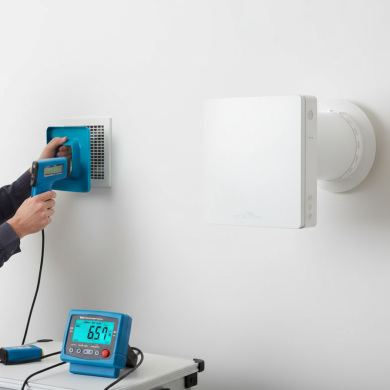
In communities like Charlottetown, Stratford, or Corner Brook, the cost of heating is a primary concern for residents, with annual bills often exceeding $3,500 CAD. A locally assembled home using the VY Build system addresses this operational cost directly. By controlling the assembly environment locally, we ensure airtightness details are executed perfectly—something difficult to achieve with stick-framing on a windy job site in November. Furthermore, keeping the production line local means the economic stimulus from housing grants circulates within the Atlantic region, paying local wages and suppliers rather than evaporating into national supply chains.
Take the next step
Transforming your municipality’s housing strategy requires a partner who understands the local landscape. VY Build offers the technology, supply chain, and operational support to turn local warehouses into housing engines.
Ready to evaluate a Hub in your region?
Contact us for a preliminary site assessment and business case consultation.
Phone: (902)-629-6699
Email: info@vybuild.ca
Website: vybuild.ca