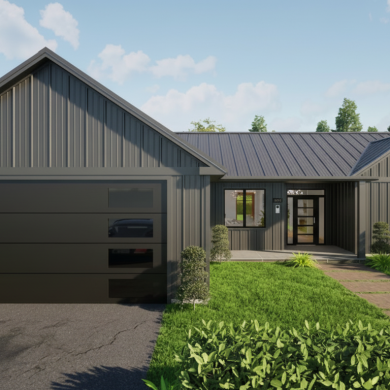
Off-Grid Field Manual: Building Net-Ready Cabins in Atlantic Canada with Insulated Woodform Blocks
Off-Grid Field Manual: Building Net-Ready Cabins in Atlantic Canada with Insulated Woodform Blocks
Building a remote cabin in Atlantic Canada presents a distinct physics problem: how do you maintain a livable interior temperature of 21°C when the exterior temperature on a windy January night in the Highlands or North Cape drops to -25°C, all without access to the grid? Most prospective builders focus immediately on the size of the solar array or the generator capacity. This is a mistake. The primary metric for off-grid success is not power generation; it is heat retention. In a climate with approximately 4,500 Heating Degree Days (HDD), a standard code-built cabin bleeds energy faster than a reasonable solar setup can replace it during the short days of December. This article provides a technical field kit for DIYers and contractors planning remote builds in PEI, Nova Scotia, and New Brunswick for 2026. We will examine how using R-32 insulated woodform blocks changes the calculus of off-grid sizing, allowing for smaller battery banks, reduced generator dependency, and feasible net-ready performance even in deep winter.
The Physics of Autonomy: Reducing the Heat Load
The financial viability of an off-grid project is determined by the building envelope. In Atlantic Canada, the challenge is “passive survivability”—the ability of the structure to maintain non-freezing temperatures during a power failure or fuel shortage. Traditional 2×6 framing with R-20 batt insulation creates significant thermal bridging (heat loss through the studs), which accounts for roughly 15-20% of wall heat loss. In a remote scenario, every watt of heat lost through a stud is a watt that your battery bank must store or your generator must produce.
By utilizing VY Build’s insulated woodform blocks, builders achieve a continuous R-32 thermal barrier with zero thermal bridging. This structural efficiency drastically alters the heating load calculation. For a 600-square-foot microhome, the difference in peak heating load between a standard build and a woodform block build can be the difference between needing a massive 30kWh battery bank (prohibitively expensive) and a manageable 10-15kWh system. The insulated woodform block acts as both the structure and the insulation, creating a tightness that prevents the “stack effect” common in cabins, where warm air escapes through the ceiling and pulls cold air in through the floor.
Key Engineering Advantage: The thermal mass and airtightness of the woodform system flatten the temperature curve. Instead of the interior temperature plummeting immediately when the heat source is off, the high-performance shell holds latent heat, reducing the cycle rate of heating equipment and extending battery autonomy.
Sizing the Heart: Solar, Storage, and Heating for Maritime Winters
Designing a power system for July in PEI is easy; designing for January requires precision. In Atlantic Canada, we experience significantly reduced solar insolation in winter, often compounded by snow cover. A “net-ready” design must assume the worst-case scenario: three consecutive days of cloudy weather with temperatures below -15°C (5°F).
Heating Strategy: Electric resistance heating is not viable off-grid due to high amperage draw. The solution is a cold-climate air source heat pump sized specifically for the low load of the R-32 shell. Because the insulated woodform blocks retain heat so effectively, you can often downsize the heat pump unit, reducing the startup surge current (locked rotor amps) that often trips off-grid inverters. For a typical micro-cabin built with this system, a 9,000 BTU hyper-heat unit is often sufficient, drawing less than 800 watts while running.
Hybrid Energy Model: While a 100% solar solution is possible, it is capital inefficient for the Maritime winter. The most robust 2026 field setup involves:
- Solar Array: Oversized relative to summer needs (e.g., 4kW-6kW) to harvest diffuse light in winter.
- Battery Storage: LiFePO4 chemistry, sized for 2 days of autonomy (approx. 10-15kWh for a conservative user).
- Backup: A small propane generator or wood stove. In an R-32 woodform home, the wood stove serves as a backup that may only need firing once a day, rather than continuously, saving cords of wood and labor.
Logistics for the Remote Build: Crane-Free Assembly
One of the largest hidden costs in remote construction is logistics. Getting materials to a site accessible only by a Class 4 logging road or a weight-restricted bridge can double transportation costs. Prefabricated modular homes often require cranes and flatbed trucks that simply cannot access deep rural properties in the Maritimes.
The insulated woodform block system resolves this logistical bottleneck through modularity at the component level. The blocks are flat-packed and lightweight enough to be offloaded by hand or with small machinery (like a skid steer). A team of two DIY builders can carry the components for an entire wall system into a site that a concrete truck or crane could never reach.
Construction Velocity: Because the blocks integrate framing, insulation, and sheathing in one step, the building shell can be weather-tight in a matter of days, not weeks. This is critical in Atlantic Canada, where weather windows are unpredictable. Rapid assembly prevents moisture damage to interior materials during construction—a common failure point in protracted stick-frame builds exposed to Maritime rain and fog.
Foundation Options: For remote sites, heavy concrete foundations are often unfeasible. The woodform system pairs exceptionally well with helical screw piles or post-and-beam foundations. This approach minimizes site disturbance (crucial for conservation areas) and eliminates the need for concrete mixers.
Field Kit: Actionable Tips for 2026 Builders
- Conduct a Solar Pathfinder Survey: Before felling a single tree, map your solar window for December 21st (winter solstice). Shadowing from spruce trees is the enemy of winter autonomy.
- Prioritize Air Sealing: Even with R-32 blocks, use high-quality tape and sealants at the floor-to-wall and wall-to-roof junctions. The wind off the Northumberland Strait will find any gap.
- Contact VY Build Early: We can assist with the heat load calculations specific to your floor plan, ensuring you don’t overspend on heating equipment you don’t need.
- Plan for Propane Backup: A dual-fuel strategy is the safest bet for Atlantic Canada. Use a small propane tank for cooking and backup heating to relieve electrical load during snowstorms.
The Economics of Efficiency: Diesel vs. Envelope Investment
Many remote camps in Atlantic Canada still rely on diesel generators running 24/7 or act as “weekend-only” camps because they take too long to heat up. This is an outdated financial model. When analyzing the Total Cost of Ownership (TCO) over 10 years, investing in a high-performance R-32 envelope allows you to replace operational expenditures (diesel/propane) with capital expenditure (insulation/solar) that pays dividends immediately.
| Metric | Standard 2×6 Cabin (R-20) + Generator | VY Build Net-Ready Cabin (R-32) + Solar Hybrid |
|---|---|---|
| Annual Heating Load | High (approx. $3,000+ in fuel) | Low (approx. $600 equiv. or free solar) |
| Maintenance | High (Gen maintenance, fuel hauling) | Low (Passive system, minimal moving parts) |
| Comfort | Drafty, cold floors, rapid heat loss | Consistent temp, acoustic dampening |
| Resale Value | Depreciating asset (old tech) | Premium asset (Net-Zero Ready) |
Funding Pathways 2026: For those building primary residences in rural areas, various programs are aligning to support electrification. While specific rebates change, the trend in Nova Scotia, PEI, and Newfoundland is to incentivize the removal of fossil fuels. EfficiencyPEI and federal initiatives frequently offer rebates for high-performance windows, insulation upgrades (relevant for retrofits or new additions), and solar implementation. Building a “Net-Zero Ready” structure qualifies you for the highest tiers of future-proofing, ensuring your asset remains valuable as building codes tighten.
Conclusion
Building off-grid in Atlantic Canada is not about conquering the elements with brute force; it is about adapting to them with smart engineering. The era of the drafty, generator-dependent camp is ending. By prioritizing the building envelope using VY Build’s insulated woodform blocks, you reduce the energy demand to a level where solar autonomy is not just a dream, but a mathematical certainty. This approach lowers long-term operating costs, simplifies logistics in remote terrain, and provides a level of comfort previously unattainable in off-grid living. Whether you are a DIY enthusiast or a contractor looking for a competitive edge in the rural market, the path to a net-ready future starts with the shell.
Ready to design your off-grid project? Contact VY Build today to discuss your remote site requirements and get a free quote on our insulated woodform block systems.
Phone: (902)-629-6699
Email: info@vybuild.ca
Website: vybuild.ca