The Atlantic DIY Playbook: Building an R-32 Micro-Home in One Weekend
Did you know that labor costs now account for over 50% of the construction budget for new builds in Atlantic Canada, primarily due to the severe trade shortage? For housing co-operatives, community land trusts, and first-time buyers in PEI and Nova Scotia, the barrier to entry isn’t just the cost of materials—it’s the complexity of assembly. This article provides a comprehensive technical playbook for bypassing the skilled labor bottleneck using pre-engineered insulated woodform blocks. You will learn how to organize a community ‘barn-raising’ style build that delivers an R-32 energy-efficient shell in just 48 hours.
We will cover the specific logistics of deploying 200–400 sq ft accessory dwelling units (ADUs) or starter homes using volunteer labor. From navigating the 2020 National Building Code energy tiers to managing ferry logistics for rural sites, this guide offers a replicable model for high-performance, affordable housing Charlottetown and rural Atlantic communities can implement today. This is not a theoretical discussion; it is a tactical manual for assembling high-performance structures with minimal tools and maximum thermal efficiency.
The Technology: Why Insulated Woodform Blocks Enable Volunteer Builds
Traditional stick framing requires Red Seal carpentry skills to ensure structural integrity and proper thermal breaks. A standard 2×6 wall with R-20 batt insulation is prone to thermal bridging and installation errors that compromise air tightness. For a volunteer crew, stick framing is slow and risky.
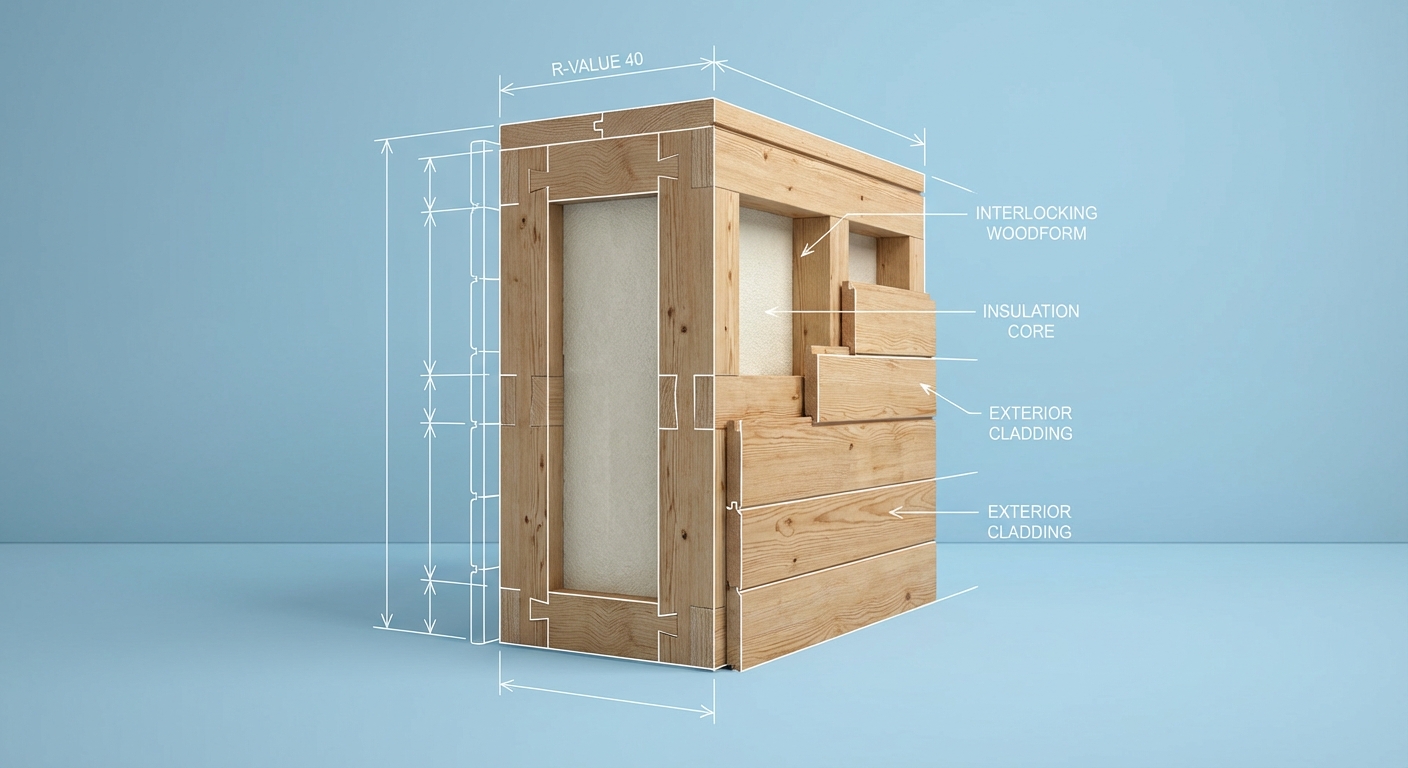
The solution for the 2026 Atlantic housing market lies in insulated woodform blocks. These are modular, lightweight structural units that combine framing, insulation, and air barriers into a single component. They eliminate the need for measuring, cutting, and complex layout work on site.
Performance Comparison: Woodform vs. Traditional Stick Frame
| Metric | Traditional 2×6 Stick Frame | Insulated Woodform Blocks |
|---|---|---|
| R-Value (Effective) | ~R-17 (nominal R-20 batt) | R-32 Continuous |
| Assembly Speed | 3-5 Days (Framing + Insulation) | 1-2 Days (Integrated) |
| Skill Requirement | High (Carpenters needed) | Low (Supervised Volunteers) |
| Air Tightness | Variable (Requires poly details) | Superior (Interlocking joints) |
| Weight per Unit | N/A (Individual studs) | < 50 lbs (Safe for 1 person) |
By using R-32 insulated woodform blocks, community groups can build energy efficient homes PEI residents need without waiting months for available framing crews. This system is particularly advantageous for net zero home PEI projects where air tightness is the primary success factor.
Logistics and Permitting: Atlantic Canada Specifics
Building in the Maritimes requires specific attention to wind loads, salt spray, and logistical staging. A project in Summerside faces different challenges than a remote build in Cape Breton.
The “Lock-Up” Inspection Protocol
Municipal building inspectors in Charlottetown and Stratford are familiar with traditional framing. To smooth the permit process for woodform blocks:
- Pre-Submission Engineering: Ensure your kit comes with stamped engineering drawings valid for PEI/NS/NB. VY Build provides these packages to satisfy Section 9 of the National Building Code.
- The “Open” Inspection: Schedule your framing inspection before applying interior finishes. Unlike ICF (Insulated Concrete Forms) where concrete hides the structure, woodform blocks allow inspectors to see the connections and tie-downs before drywall is applied.
- Energy Compliance: For 2026 Tier code compliance, submit the R-32 specification sheet with your initial permit application. This pre-validates the energy modeling required for efficiencyPEI rebates.
Rural Delivery Staging
For island builds or rural Nova Scotia sites, timing is critical. Weight restrictions on rural roads during the spring thaw (March–May) can delay heavy material delivery. Unlike heavy ICF pallets or modular crane-lifts, woodform block pallets are lighter and can often be offloaded with a standard Moffett forklift attached to the delivery truck, eliminating the need for expensive crane rentals on site.
The 48-Hour Weekend Build Schedule
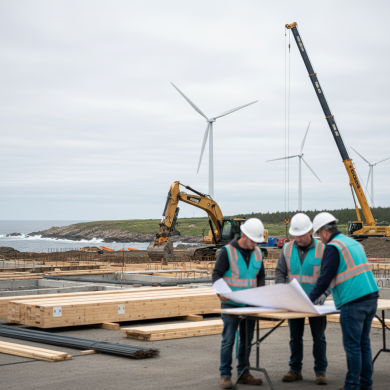
This timeline assumes a 300 sq ft starter unit, a pre-poured slab or helical pile foundation, and a crew of 6 volunteers led by 1 site supervisor.
Day 1: The Envelope Rise (08:00 – 17:00)
08:00 – 09:00: Safety Brief & Station Assignment. Designate a “Cut Station” (though minimal cutting is needed) and an “Assembly Line.” Review lifting mechanics.
09:00 – 12:00: First Course & Corners. Setting the first course is the only step requiring precision leveling. Once the corners are square and level, the interlocking nature of the blocks ensures the rest of the wall remains plumb.
12:00 – 13:00: Lunch.
13:00 – 17:00: Wall Assembly to Lintel Height. Teams of two pass blocks. The lightweight nature allows rapid vertical progress. Install rough bucks for European windows Atlantic Canada standard sizes (Tilt & Turn models recommended for air sealing).
Day 2: Structural Lock & Roof Prep (08:00 – 16:00)
08:00 – 11:00: Top Plate & Lintels. Install the structural wooden top plate which ties the block walls together. This acts as the rim joist bearing for the roof system.
11:00 – 14:00: Truss/Rafter Installation. Whether using pre-fab trusses or engineered I-joists, these are secured directly to the woodform top plate.
14:00 – 16:00: Weatherproofing. Apply the weather-resistive barrier (house wrap) immediately. Because the blocks provide a solid backing, stapling and taping the wrap is faster than on open stud bays.
Practical Tips for Volunteer Builds
- The “Golden” First Course: Spend 50% of your mental energy on the first hour. If the bottom row of blocks is perfectly level, the rest of the house builds itself.
- Tool List Rationalization: You do not need air compressors or nail guns for the block assembly. A rubber mallet and cordless impact driver are the primary tools.
- Window Strategy: Order your triple pane windows cold climate rated 12 weeks in advance. European tilt-and-turn windows are heavy; schedule their installation for a separate day with a smaller, stronger crew.
- Contact VY Build early: We can assist with the quantity takeoff to ensure you have exactly the right number of corner and straight blocks, minimizing waste.
Financing the Project: Grants and Energy Rebates
Affordability isn’t just about construction costs; it’s about operating costs. An R-32 wall system significantly lowers the heating load, making the home eligible for substantial rebates.
Leveraging efficiencyPEI and Federal Programs
Building to this standard opens doors to the efficiencyPEI New Home Construction incentives. A home built with R-32 walls, R-60 roof, and triple-pane glazing often exceeds the target for Net Zero Ready certification.
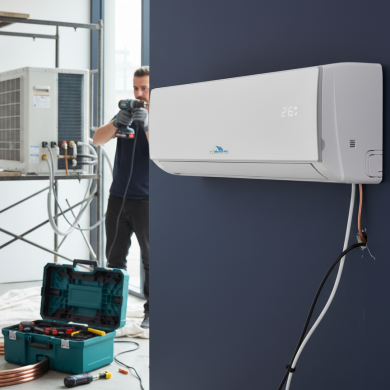
For community groups, the low heating demand (approx. $400/year for a 400 sq ft unit) means monthly dues or rents can be kept artificially low. When calculating the budget, factor in the elimination of a central furnace. A single high-efficiency mini-split heat pump installation PEI contractors provide is sufficient to heat and cool the entire structure, reducing mechanical costs by thousands.
Atlantic Community Context
In communities like Stratford, Cornwall, and rural Kings County, the “missing middle” of housing is acute. Large developers focus on massive subdivisions, leaving a gap for ADUs and small-footprint homes. The woodform block system is uniquely suited for Maritime winters. Unlike traditional timber which can warp if exposed to wet snow during framing, the insulated components are dimensionally stable.
Furthermore, the wind resistance of the interlocking block system provides superior protection against the nor’easters common in the Northumberland Strait. By choosing this method, you are building resilience into the community infrastructure.
Next Steps for Your Project
The transition from a raw piece of land to a weather-tight shell in 48 hours is possible, but it requires precise material planning. At VY Build, we specialize in high-performance building envelopes tailored for the Atlantic climate.
Ready to plan your build?
Contact VY Build for a free consultation regarding your material list and engineering requirements.
Phone: (902) 314-7455
Email: info@vybuild.ca
Website: vybuild.ca
Conclusion
The housing crisis in Atlantic Canada demands innovation, not just in policy, but in physics. By shifting from stick framing to insulated woodform blocks, community groups and DIY builders can bypass the labor shortage and construct affordable housing Charlottetown needs now. This weekend-build protocol delivers a structure that is stronger, warmer, and faster to assemble than any conventional method. Whether you are a co-op organizer or a first-time land owner, the path to a high-performance, R-32 home is now a kit you can assemble with your neighbors.