VY-BM180 Electric Boiler: Heating Oil Switch Math
VY-BM180 Electric Boiler: Heating Oil Switch Math
If your home still burns heating oil, you already know the feeling: a delivery truck pulls up, and a few hundred dollars evaporate in twenty minutes. Across Atlantic Canada, a significant share of households still rely on furnace oil for central heat — and every year those homeowners ask us the same question: does switching to an electric boiler actually pay off?
The honest answer is that it depends on your fuel bills, your electricity rate, and which rebates you can stack. So instead of hand-waving, let's walk through the real math behind the VY-BM180 Electric Boiler — what it does, what it costs to run, and how contractors and homeowners can frame a payback conversation that actually holds up.
Why Oil-to-Electric Is Back on the Table
The economics of home heating have shifted. Fossil-fuel prices are volatile, carbon pricing has layered onto every litre of furnace oil, and the electricity grid across the Maritimes keeps adding renewable capacity. That combination is exactly why we brought the BM series to our catalog — as the product description puts it, "the rising costs of fossil fuels and growing concern for the environment are bringing about an energy revolution," and electricity "is becoming one of the main energy sources in the heating market."
There's a workforce angle too. Employment & Social Development Canada's August 2025 Atlantic Construction Sector Profile confirms roughly 23% of the region's construction workers will retire over the next decade. For contractors, that labour crunch means simpler, faster mechanical installs matter — and an electric boiler that ships with its circulation pump and expansion vessel already integrated is a meaningfully quicker install than a full oil-fired system with tank, flue, and fuel line.
What the VY-BM180 Actually Delivers
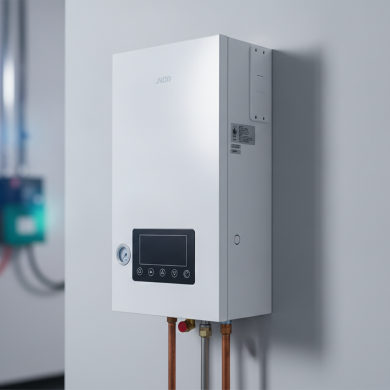
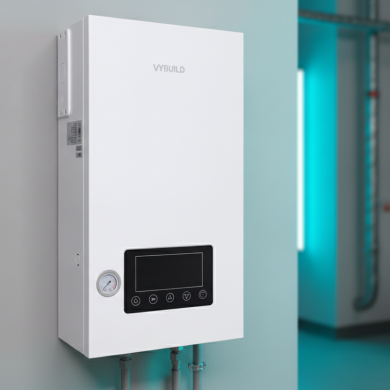
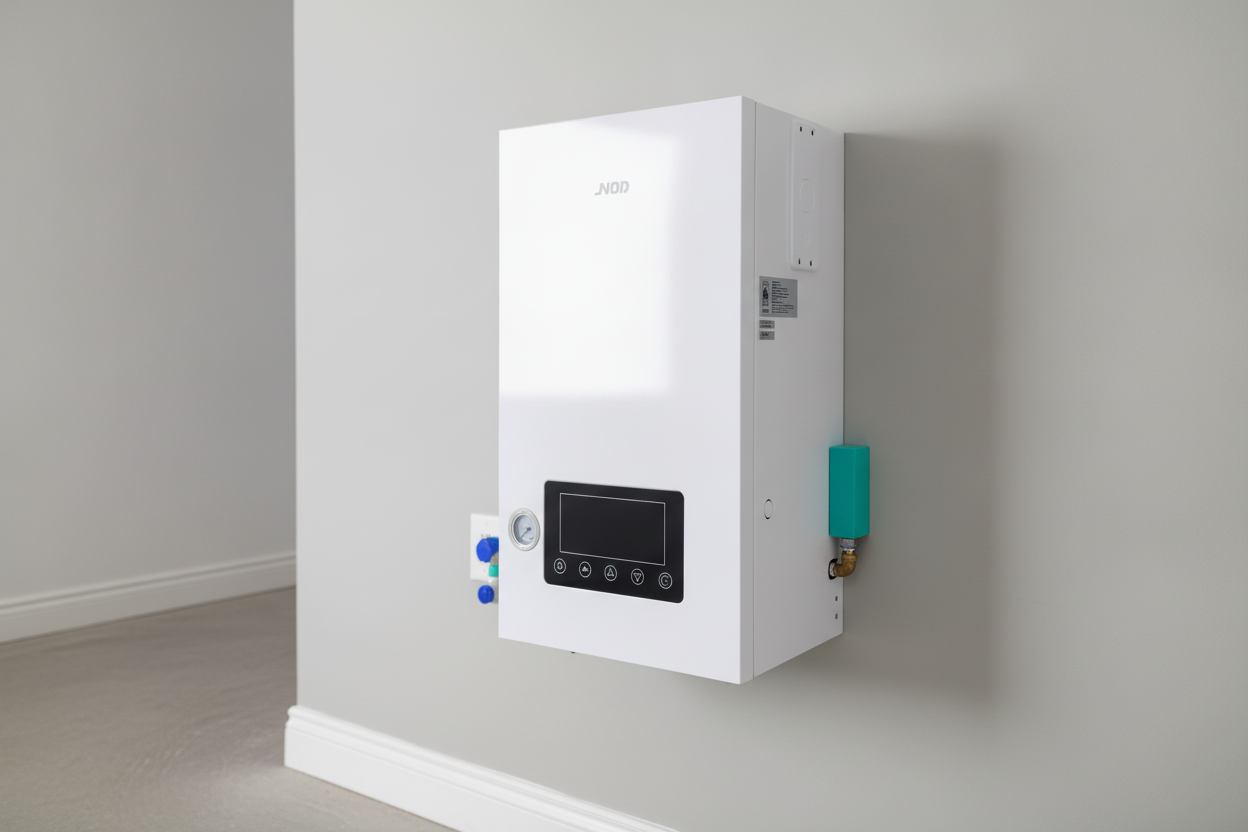
We want to be precise here rather than overstate anything. Based on its actual specification, the VY-BM180 is a single-zone electric central heating unit that provides both central heating and domestic hot water without burning any fossil fuel on site. Our catalog lists these confirmed features:
- ETL-certified output from 12 kW to 18 kW — sized for a range of Maritime home footprints.
- Integrated circulation pump and expansion vessel — which the manufacturer notes "makes them easy to install."
- Wi-Fi control by connecting with the room thermostat or app.
- Domestic hot water compatibility via connection to an indirect water heater or buffer tank.
- A patented heating element engineered for high heating efficiency.
- A closed waterway system, touch-key LED display, and ultra-low-noise operation.
- Safety layers: double dry-heating protection, automatic anti-freezing, and fault auto-detection.
The Wi-Fi zoning and app control matter more than they sound. Remote scheduling means you're not paying to heat an empty house, and the anti-freezing function is a genuine peace-of-mind feature for seasonal properties and cottages that sit cold between visits.
The Switch Math: How to Frame Payback
Here's the framework we walk homeowners through. We won't publish a single "magic" payback number, because your inputs vary — but the structure is what matters.
Step 1 — Establish your current oil cost per season. Add up your annual furnace-oil deliveries. Multiply litres by your delivered price. That's your baseline.
Step 2 — Estimate your annual heat demand in kWh. Furnace oil delivers roughly 10 kWh of energy content per litre, but an aging oil furnace loses a chunk of that up the flue. So your useful heat delivered is lower than the raw energy you paid for.
Step 3 — Convert that useful demand to electric input. Because the VY-BM180 uses a closed-loop resistance element, nearly all the electricity it draws becomes usable heat in your water loop. Multiply your useful heat demand by your provincial electricity rate (check your latest Maritime Electric, NB Power, or Nova Scotia Power bill for your exact ¢/kWh).
Step 4 — Compare the two annual totals. The gap between your oil season and your electric season is your gross annual saving. Then divide the installed cost of the boiler (minus rebates — see below) by that annual saving to get a payback period in years.
The reason we hand contractors this framework rather than a fixed figure is that landing pages full of "guaranteed savings" don't survive an informed buyer's scrutiny. A homeowner who runs their own numbers on their own bill trusts the result — and closes.
Rebate Stacking and the Renewal-Rate Reality
Check current program status before quoting any incentive — programs open and close, and we only point clients to what's genuinely active at the time of their install. Provincial efficiency organizations across NS, NB and PEI have historically offered electrification and heating-upgrade rebates, and stacking a provincial incentive against the boiler's installed cost is what compresses the payback period from "eventually" to "a few seasons." Always verify the exact program and its live status with the homeowner before it goes on a quote.
There's also a household-budget backdrop worth naming. The Bank of Canada's 2026 Financial Stability Report warns that a large share of Canadian mortgages — 52% of the total — will renew by the end of 2027, and many households face higher payments on renewal. For those homeowners, a predictable electric heating bill they can schedule and control via app is easier to budget than an oil delivery that swings with global fuel markets. Cost certainty is itself a benefit.
Who Should Actually Make the Switch
We don't recommend electric boilers to everyone. The candidates who see the strongest case are:
- Homes with a currently aging or failing oil furnace (you're spending the capital anyway).
- Properties with reasonable electrical service capacity to accept a 12–18 kW load.
- Owners who value zoned, app-controlled scheduling and want to eliminate on-site combustion.
- Builders spec'ing net-zero-ready homes who want to keep the mechanical room fossil-fuel-free.
For our own high-performance builds — the kind pairing tight envelopes with low heat demand — an electric boiler's sizing sweet spot lines up well, because a well-insulated home simply needs fewer kilowatts to stay warm.
Key Takeaways
- The VY-BM180 is an ETL-certified electric boiler, 12–18 kW, delivering central heat and domestic hot water with no on-site fossil fuel.
- It ships with an integrated pump and expansion vessel plus Wi-Fi/app control, simplifying both install and daily operation.
- Payback isn't a fixed number — run your actual oil bill vs. your provincial ¢/kWh rate, then subtract active rebates before dividing by installed cost.
- Verify rebate status (NS/NB/PEI efficiency programs) at quote time; stacking is what compresses payback.
- Best-fit candidates are homes with failing oil systems, adequate electrical capacity, and a preference for cost-predictable, controllable heat.
Ready to Run Your Numbers?
If you're a contractor spec'ing a heating retrofit, or a homeowner tired of watching the oil truck drain your budget, start with the full specification. Explore the VY-BM180 Electric Boiler and reach out to our team — we'll help you build a payback estimate around your real bills, not a marketing guess.