

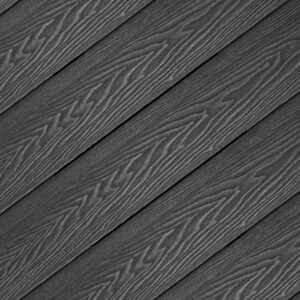
Composite Decking Board 5-5/8″ x 7/8″ x 12′ — Capped WPC, Dark Grey
$32.90
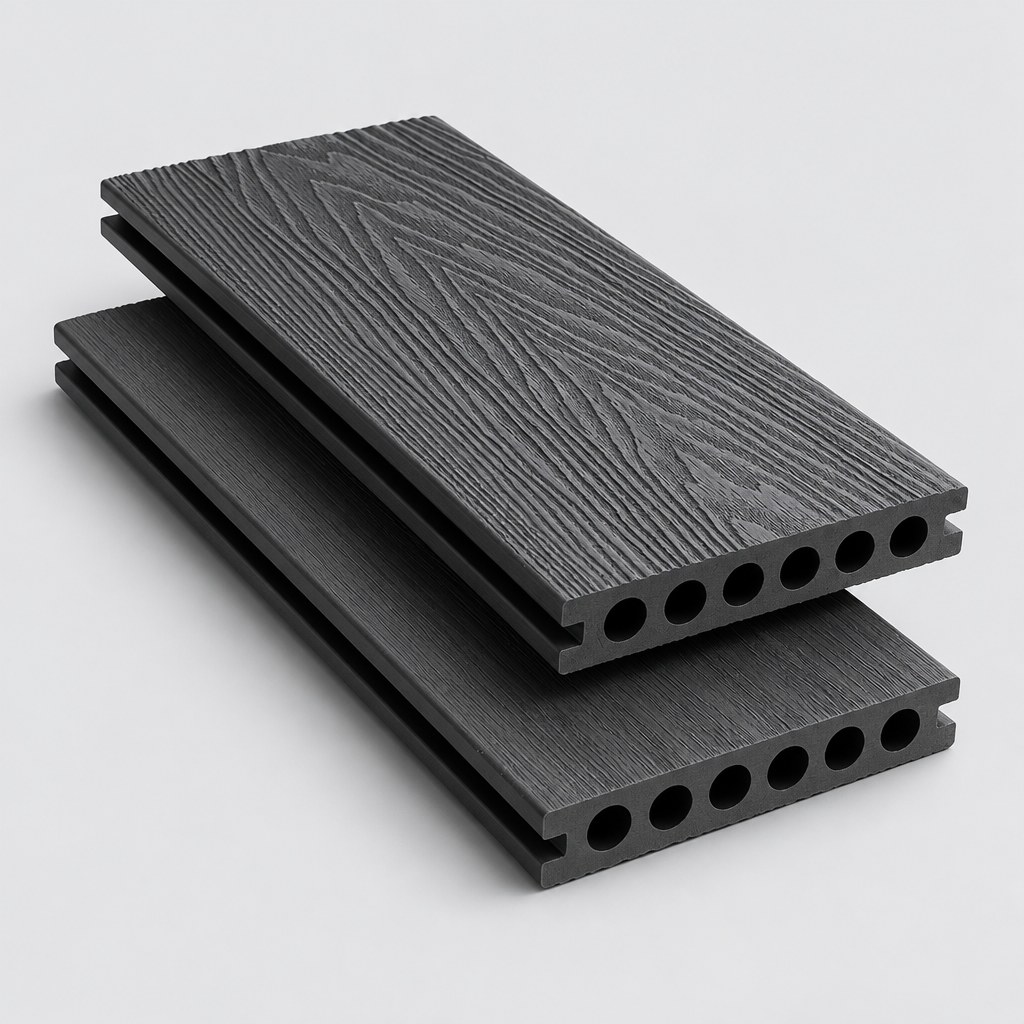
Capped composite deck board, 12 feet, in dark grey. An acrylic cap over a wood-fibre and HDPE core — the weather lands on the cap, not the core. No sanding, no staining: a wash and that is the season. One board covers 5.59 sq ft. Grain side up — the grooved underside is not capped.
Every spring on the Island somebody is out on their knees with a belt sander and a tin of stain, doing the same job they did two springs ago. A wood deck here does not fail dramatically. It just starts asking for things — a board swapped where the cupping got bad, a screw backed out, a face sanded before barbecue season opens.
This board does not ask. The core is wood fibre bound into high-density polyethylene; over it runs a co-extruded acrylic cap that takes the fog, the salt in the air off the water and the freeze-thaw cycle that runs from November into April. The weather lands on the cap, not on the core.
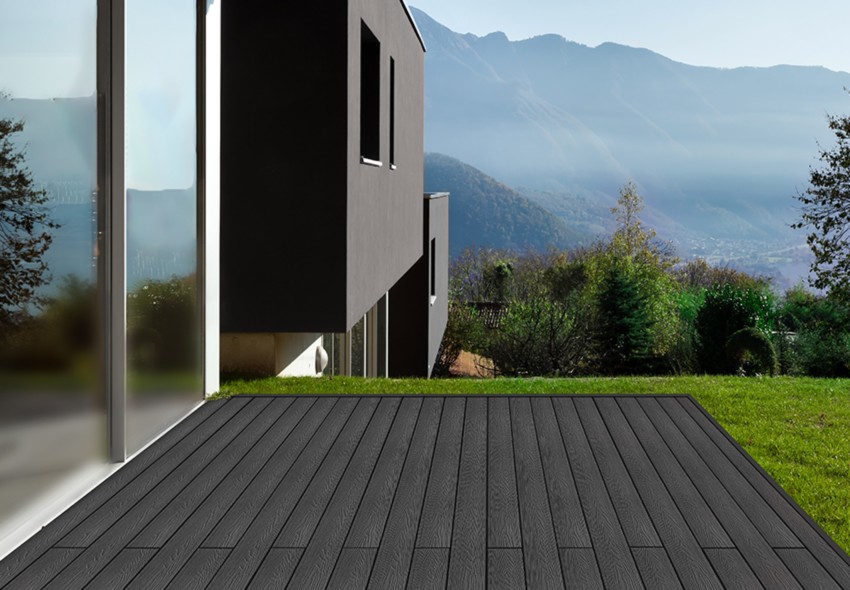
Dark grey is the colour doing the work right now. It sits under black window frames and black railings the way nothing else does, it does not show the pollen in June or the dust off a gravel drive, and it never passes through the awkward orange-to-silver stage a wood deck goes through on its way to weathered. Twelve feet long means fewer butt joints across a typical run — and a butt joint is where a deck starts to look its age.
How the board is built
A closed-cell core of wood fibre and high-density polyethylene, with a co-extruded cap of engineered acrylic polymer over it. The cap is what carries the grain and the colour, and it is what keeps water and UV out of the core. That is the same construction as the capped boards the big brands sell — not the uncapped composite that chalks and stains after two seasons.
Grain side up — this board is not reversible
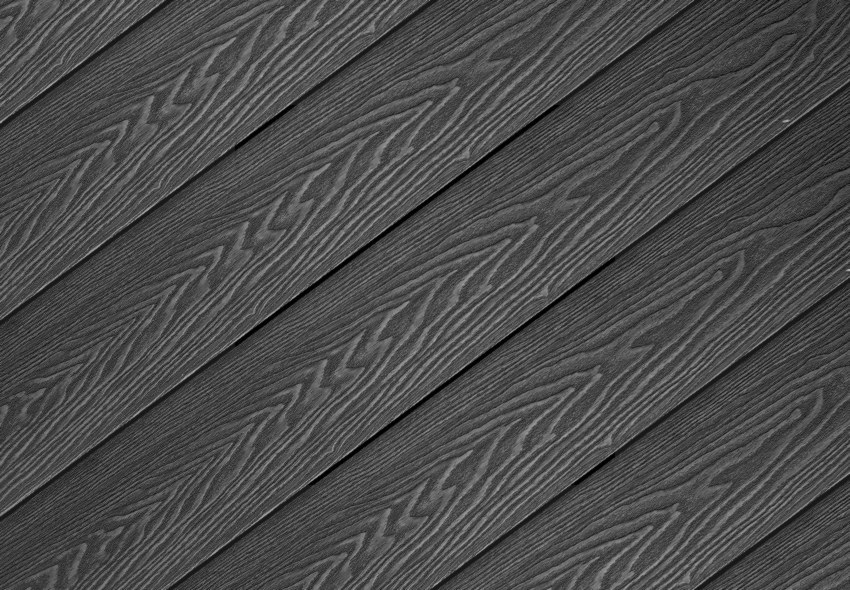
One face carries the Dragon wood grain and the cap. The other face is grooved and is not capped. It belongs face down on the joists. A board laid grooved side up has an unprotected core facing the weather, and it will not behave like the board you paid for. If you want a finished edge where a cut end or a perimeter shows, use the edge board — that one is capped all round.
Working with it
- Cut, drill and fasten with ordinary woodworking tools and carbide blades.
- Stainless steel fasteners outdoors. On the Island, galvanized will stain within a season or two near salt air.
- Composite expands and contracts along its length with temperature. Leave a gap at butt joints and at any fixed obstruction, and follow the gap table on the joist spacing you are using.
- Joist spacing matters more with composite than with wood. Closer centres than you would use for 5/4 cedar, and closer again if the deck is at an angle or carries a hot tub.
- Do not use it as a structural member. Composite decking carries the walking surface, not the frame.
What it is not
It is not maintenance-free — it is low maintenance. It still wants a wash. It is not slip-proof: we hold no slip-resistance test report for this board and will not quote a rating for it. And we do not publish a warranty figure for it until the manufacturer’s warranty document is in our hands and checked.
Specifications
- Actual size 142 × 23 × 3,660 mm (5-5/8″ × 7/8″ × 12′)
- Round hollow chamber core — lighter to handle, same walking surface
- Cap: engineered acrylic polymer, co-extruded, Dragon grain
- Core: wood fibre and high-density polyethylene
- Coverage 0.52 m² = 5.59 sq ft per board
- 9.5 kg per board
- Colour: Dark Grey
Three ways to buy
Board by board, by the lift, or by reserving a share of the next container before it ships. Nothing is held back and there is no sale price — the number depends only on how you buy.
From above, every composite deck board looks like every other one. Saw one through and three quite different boards appear. The cross-section decides how much material is in your hands, where that material sits, and what the board does with water.
- Cross-section
- Open channels milled out of the underside. The least material of the three.
- Cap
- Usually the face and both edges. The scalloped underside is bare core.
The cheapest way to make a composite board, and it is a reasonable one. But the channels stay open to the joist bay, and over a winter they hold water, leaves and ice.
- Cross-section
- Round chambers running the length of the board, between a continuous top skin and a continuous bottom skin. Nothing is cut away from the underside.
- Cap
- Co-extruded acrylic polymer on the grain face, in dark grey. Grain side up — the grooved reverse is not capped and faces the joists.
- Weight
- 9.5 kg for a 12-foot board.
Material kept top and bottom, air in the middle. It is lighter to carry up a ladder and lighter to ship than a solid board, and the underside stays a closed surface rather than a row of open troughs.
- Cross-section
- No voids at all.
- Cap
- Face and both edges on the better lines.
The stiffest of the three and the quietest underfoot — and the heaviest to handle and the dearest per square foot, because you are paying freight on material in the middle of the board that carries very little.
Set joists at 16 inches on centre, and closer for stairs or an angled layout. What this board actually did under load, under water and under UV is measured and published just below. And what you still cannot tell from a photograph you can tell from a cut end — ask and we will send you one.
Tested to EN 15534-4:2014 by an independent third-party laboratory — report 241025005SHF-001, December 2024, with the weathering run in report 241025005SHF-003. Each bar below is what this board measured against what the standard allows. The whole bar is the limit. Shorter is better.
28 days fully immersed
over those same 28 days
500 N on the test span
1 kg dropped from 700 mm
Maximum load 4,312 N. The standard asks for 3,300 N as a mean and 3,000 N as a minimum.
Colour change ΔE 1.18 after 2,000 hours of accelerated weathering to EN ISO 4892-2, grey scale 4–5 throughout. Below 2 is a difference you only see with the original board held beside it. The standard sets no limit here — it asks for the number to be declared, and that is the number.
Impact, creep and RoHS all passed. No crack from a 1 kg mass dropped 700 mm, creep well inside the limit, and none of the ten restricted substances detectable.
What we are not claiming. No slip class and no fire class. We hold those reports, but they were run on a solid board, not on this hollow profile, and a safety figure borrowed from a different board is worse than none. They go up here when we have them for this one. Figures above were measured on the 140 mm width of the same profile; the board sold on this page is 5-5/8″ wide.
Construction, the two colours, the EN 15534-4 test figures, joist spacing and board counts, and all three price channels.
Related products


VY Build IC90 Subfloor Construction Foam Adhesive
Price range: $16.80 through $187.95


12000 BTU Cold-Climate Mini Split Heat Pump · SEER2 25 · R-454B
Price range: $1,549.00 through $3,177.00
